
Nvidia vs AMD
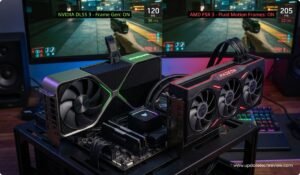
We are currently living in the age of AI. Every major company is training massive models and answering queries from millions of users on a daily basis. At the forefront of all this, two names dominate the conversation: Nvidia vs AMD.
Both companies are manufacturing powerful AI chips; however, the critical question remains: which one will be the better choice for your specific needs in 2026? Does Nvidia still reign supreme, or has AMD successfully closed the gap?
In this article, we will compare Nvidia vs AMD using simple, accessible language. We will evaluate which company holds the lead based on performance, pricing, memory capabilities, software ecosystems, and real-world application. If you are involved in the AI business, manage a data center, or are working on your own AI project, you will find this article to be an invaluable resource.
Introduction to Nvidia vs AMD AI Chips
Nvidia has long been the undisputed leader in the world of AI chips. Its Blackwell series (including the B200 and GB200 models) remains incredibly popular. These chips are exceptionally fast at training large-scale AI models.
AMD is not far behind. Its Instinct MI350 series (comprising the MI350X and MI355X) launched during the 2025–2026 timeframe. AMD asserts that these chips offer a more cost-effective solution while delivering superior performance in specific workloads.
Both companies are manufacturing their chips using TSMC’s advanced process nodes. While Nvidia maintains a primary strength in the realm of AI training, AMD is demonstrating strong performance in inference (the process of running AI models).
Key Features of Nvidia AI Chips in 2026
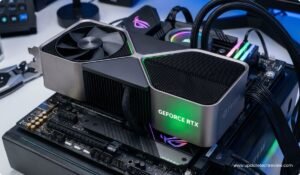
Nvidia’s Blackwell architecture has been a major topic of discussion throughout 2025 and 2026. The GB200 “Superchip” delivers immense processing power by combining two Blackwell GPUs.
It features high memory bandwidth, which facilitates the rapid processing of massive AI models. Furthermore, Nvidia’s NVLink technology allows for the seamless interconnection of multiple GPUs.
Nvidia’s greatest competitive advantage lies in its CUDA software platform. The vast majority of AI developers and researchers rely on CUDA for their work, making the training process significantly easier and faster.
As of 2026, Nvidia continues to command a dominant market share, holding between 80% and 90% of the total market. Major cloud providers and enterprises typically choose Nvidia by default.
Also Read:-
The Power of AMD’s MI350 Series AI Chips
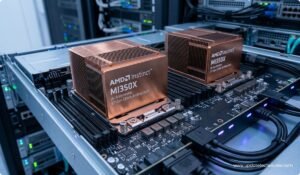
AMD launched its MI350 series in 2025. The MI355X features 288 GB of HBM3E memory—a capacity that exceeds that of many Nvidia models. Its memory bandwidth is also exceptionally high.
AMD claims that, for inference tasks, these chips offer superior “tokens-per-dollar” efficiency—meaning they deliver more work for less money. Many hyperscalers (such as Meta) are now utilizing AMD as a secondary source.
The ROCm software ecosystem has improved significantly compared to its earlier iterations. Tools like vLLM and SGLang now perform effectively on AMD hardware. Furthermore, AMD chips often demonstrate greater power efficiency.
Nvidia vs. AMD – Performance Comparison (2026)
Nvidia still maintains the lead in the realm of training (model creation). Thanks to the robust CUDA ecosystem, Nvidia delivers more stable and faster performance within large-scale clusters.
In the domain of inference (model deployment), AMD is putting up a strong fight. The MI350 series’ larger memory capacity allows it to handle long-form conversations or large KV caches more effectively.
Certain benchmarks indicate that AMD offers up to 40% better “tokens-per-dollar” value. However, in real-world scenarios, actual performance depends heavily on software optimization.
Overall, if your workload requires a massive training cluster, Nvidia remains the superior choice. Conversely, if you are working with a limited budget and your primary focus is on inference tasks, AMD is a compelling option worth serious consideration.
Pricing and Value for Money – Which Is More Affordable?
Nvidia’s chips come with a high price tag. While the cost of models like the B200 or GB200 is substantial, many companies justify the expense based on the performance returns they deliver.
AMD chips are generally more affordable. With the MI350 series, the combination of superior memory capacity and lower power consumption can also lead to significant savings on electricity bills over the long term.
Many industry experts suggest that AMD is capitalizing on “Nvidia fatigue.” Companies are increasingly reluctant to remain solely dependent on Nvidia and are actively seeking viable alternative solutions.
Software and Ecosystem – The Most Significant Factor
Here, Nvidia’s CUDA serves as a very strong moat. The vast majority of AI code, libraries, and tools are optimized for Nvidia.
AMD’s ROCm is continuously improving, though it is not yet as mature as CUDA. Nevertheless, companies like OpenAI and Meta are actively supporting AMD, which is helping ROCm become even more robust.
If you are starting a new project in 2026, base your decision on the available software support. For projects involving legacy code, Nvidia will likely be the easier choice.
Who Leads in 2026: India vs. the Global Market?
In India, initiatives like ‘Digital India,’ the ‘AI Mission,’ and the startup ecosystem are growing rapidly. Here, budget constraints and cost efficiency are of paramount importance.
AMD stands to capitalize on a significant opportunity in this market, given the high demand for cost-effective alternatives. However, major research institutions and cloud service providers still prioritize Nvidia.
On a global scale, Nvidia remains the market leader, though AMD’s market share is gradually expanding. Experts suggest that the AI market is vast enough to accommodate both companies, allowing them to coexist and thrive side-by-side.
Conclusion: Choosing the Best AI Chip in 2026
In the Nvidia vs. AMD debate, there is no single definitive winner. The best choice depends entirely on your specific use case.
- If you require large-scale training capabilities and stability → Choose Nvidia.
- If you prioritize better cost-efficiency, higher memory capacity, and inference performance → AMD is an excellent option.
- If you are working with a tight budget or require a secondary source of hardware → Give AMD a try.
In the future, both companies are expected to introduce even more advanced chips. The most prudent approach is to conduct small-scale pilot tests tailored to your specific requirements.
The field of AI is evolving at a rapid pace. What appears to be the best solution today may be surpassed by an even better option tomorrow. Therefore, stay informed and keep both contenders on your radar.
You also read :-
- ASUS Zenbook 14 (UX425) Review: A lightweight, premium, and best-in-class laptop with long battery life!
- ASUS Zenbook Duo UX8407 2026 Review in English
- ASUS Zenbook S16 Review in English
- OnePlus 9 Review in English OnePlus 9 Specifications, Price & Features 2025
- The OnePlus Nord N10 5G features a 90Hz display
- OnePlus 9 Review in English OnePlus 9 Specifications
- Motorola G86 Review english – Display,
- OnePlus Nord CE 4 Lite 5G Review in English | Budget 5G phone, 120Hz display & 80W charging
- iPhone 14 Pro Max Review in English
- iPhone 15 Review – Camera, Display, Battery and Price
- Samsung Galaxy S25 FE Review | Fantastic Features, Powerful Camera, and Robust AI
- Why purchase it, a PS5 review in 2026? Best Features, Games, and Price Guide
FAQ Section
Q1. Is Nvidia vs. AMD the better choice for AI chips in 2026?
Answer: Nvidia still holds the edge in training and large-scale clusters. AMD is offering strong competition in terms of inference and cost efficiency. The best choice depends on your specific requirements.
Q2. Is the AMD’s MI350 superior to Nvidia’s Blackwell?
Answer: AMD leads in certain specifications, such as memory capacity and tokens-per-dollar. However, Nvidia currently maintains a stronger position within the software ecosystem.
Q3. Which AI chip is the right fit for small businesses or startups?
Answer: For most small businesses, AMD may be the better option, as it is both more affordable and energy-efficient.
Q4. What is the difference between CUDA and ROCm?
Answer: CUDA is Nvidia’s highly mature software platform. ROCm is AMD’s equivalent; while it is continuously improving, it is not yet as user-friendly as CUDA.
Q5. What will AI chip pricing look like in 2026?
Answer: Nvidia products are expected to remain expensive. AMD offers a more affordable alternative. In the long run, increased competition may help keep prices somewhat in check.